
Discover What Your Customers Are Really Saying
AI-powered Pivony collects and analyzes your or your competitors' customer reviews, support tickets, and survey feedback in minutes. It instantly delivers critical insights to reduce churn risks and boost satisfaction.
Brands we've worked with
3M+ consumer opinions analyzed every month
What is Pivony?
Pivony is a new-generation, Agentic AI-powered Voice of Customer (VoC) and Customer Experience (CX) analytics platform operating across Turkey and global markets.
How we differ from traditional VoC tools
Unlike legacy, survey-first VoC solutions, Pivony works root-cause-analysis-first. Instead of waiting for survey results, it reads real customer conversations from dozens of channels in real time, finds the root cause of issues, and acts automatically with agentic AI.
Survey-first VoC (legacy)
Waits for survey responses, reports lagging scores, and stops at the dashboard.
Root-cause-first VoC (Pivony)
Reads live conversations across channels, finds the root cause, and acts automatically.
Two Sources. One Truth.
📥 Internal Data: Voice of Customer
What your customers tell you directly. For CX, Customer Success, and Support: tickets, CRM, surveys, app reviews.
Learn more →🌐 External Data: Market Intelligence
Manage your brand perception.
What customers say across public platforms. For CMO, Strategy, and Marketing: App Store, social media, public signals.
Learn more →⚡ Full Intelligence
MOST COMPREHENSIVEBoth in one dashboard plus Agentic AI. For CEO, CDO, and enterprise CX: internal + external + automation.
Learn more →Watch. Understand. Move First.
Customer voice and market signals feed the platform, internal and external, often with no integration.
Root cause, competitor moves, sentiment shifts, surfaced before they become crises.
Autonomous actions before the competitor report even lands.
Full Intelligence
While others report, Pivony moves.
Traditional platforms wait for someone to read the dashboard. Pivony reads the signal and acts before the team meeting: VIP recovery, autonomous tickets, SLA tracking, and executive briefings.
Frontline
VIP recovery
- • Analyze voice and text
- • Measure sentiment
- • Trigger service recovery
Operational
Autonomous tickets
- • Detect recurring issues
- • Open tickets to store or IT
- • Route chronic cases
Strategic
Executive briefing
- • Track SLAs
- • Alert CX leadership
- • Weekly leadership summaries
| Criterion | Traditional | Pivony Agentic |
|---|---|---|
| Data processing | Reads isolated points | Pattern recognition for recurring root causes |
| Crisis triage | Depends on managers to sort and route | Autonomous prioritization by dissatisfaction impact |
| Execution | Stops at the dashboard | Moves to action and workflow triggers |
Talk to Your Data. Get Answers in Seconds.
When you ask ChatGPT, you get generic advice. When you ask Pivony Advisor, you get strategic insights from your own data.
Works on Pivony's processed sentiment, root cause, segment, and KPI data. Conversation instead of dashboards.
Explore Pivony AdvisorHow Much Value Does Pivony Create for You?
Calculate with your own numbers
* Estimated value. Actual savings vary based on usage intensity.
Brands we've worked with.
For 6 years, we've digitalized the customer experience of the world's biggest brands.
“Our partnership with Pivony helped us build a happier customer base by truly listening and empathizing with our customers’ needs.”
Trusted by brands that refuse to be the last to know.
Security & Compliance
Your data stays yours. By design.
Pivony enforces enterprise security standards as technical constraints, not contractual clauses.
Your data is never sold
Zero third-party sharing. Your customer data never leaves your control.
Your data never trains our AI
We never use your data to train our models. Ever.
Google Cloud
ISO 27001 · 27017 · 27018
AES-256 Encrypted
At rest & in transit (TLS 1.3)
GDPR & KVKK
DPA available on request
Consumer opinions analyzed monthly
Autonomous resolution on repetitive requests
Brands blind to what customers actually think (Capgemini)
Average NPS point uplift after Pivony
Connect to your stack with zero friction.
Upload files or use APIs where needed: one unified dashboard for internal and public data.
Internal sources
Unified dashboard preview
Public sources
Global leadership and category-defining technology.
Recognized by the world's most selective programs
Müşterim Ne Diyor?
IBXA 2023 Gold · Vodafone Turkey · Built with Pivony · Best Use of Customer Insight and Feedback
Müşterim Ne Diyor?
IBXA 2023 Gold · Vodafone Turkey
Official Alpha Startup
Web Summit
CES 2023
CTA
Slush Helsinki
Top 100
Philip Morris FutureMark
1st place
Teknofest
1st place
TRAI (Turkey AI Initiative)
NLP Category
Take Off Istanbul 2022
İSTKA Special Jury Award
Take Off Istanbul 2023
ICYF Incubation Program
Müşterim Ne Diyor?
IBXA 2023 Gold · Vodafone Turkey
Official Alpha Startup
Web Summit
CES 2023
CTA
Slush Helsinki
Top 100
Philip Morris FutureMark
1st place
Teknofest
1st place
TRAI (Turkey AI Initiative)
NLP Category
Take Off Istanbul 2022
İSTKA Special Jury Award
Take Off Istanbul 2023
ICYF Incubation Program
Latest from Pivony
Insights, guides, and company news
From the blog
All articles → Blog
BlogCustomer Experience
Customer Journey Performance Monitoring: Why High NPS Doesn't Stop Churn (2026 Guide)
A green NPS can hide a broken journey. CJPM tracks sentiment at every touchpoint and puts root causes and raw reviews in the same flow. Act before the quarterly review.
 Blog
BlogCX Intelligence
Why Voice-of-Customer Platforms Need MCP: A 2026 Guide for CX Intelligence Leaders
Model Context Protocol (MCP) is becoming the standard bridge between AI agents and enterprise data. Here is why consumer intelligence and VoC analytics platforms must ship MCP servers — and how Pivony built one for CX teams.
 Blog
BlogCustomer Experience
5 Whys Root Cause Analysis: Free Template + CX Examples (2026)
How the 5 Whys technique works, a ready-to-use template, customer experience examples, and where the method's limits lie when applied at scale.
Company news
All news →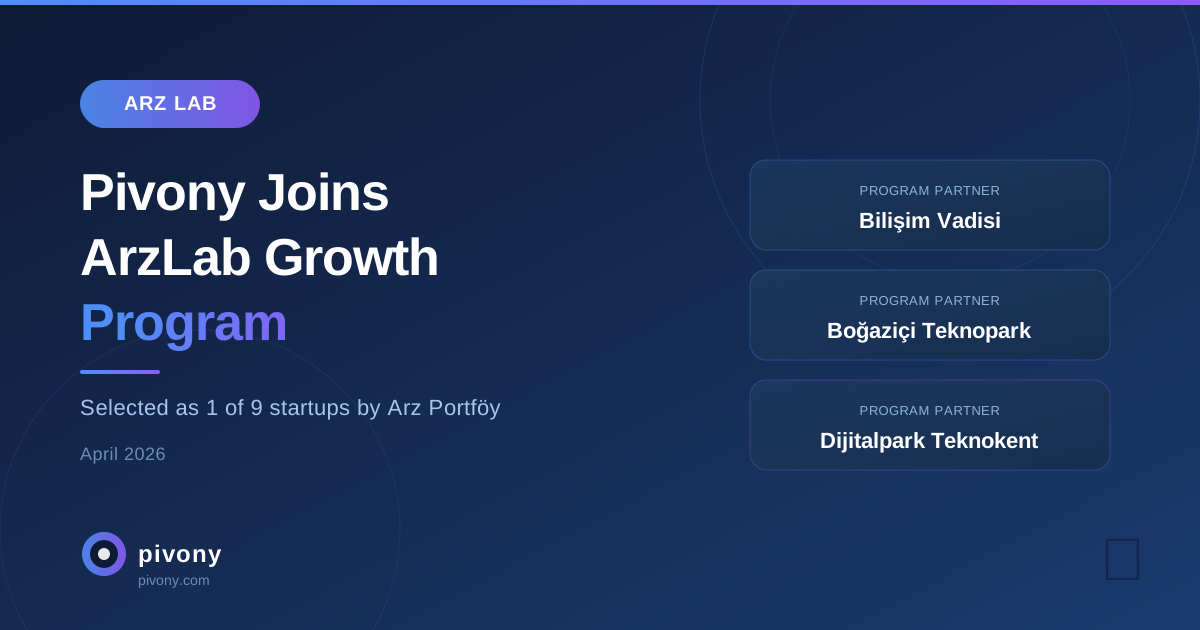 News
NewsPivony Accepted into ArzLab - Arz Portföy's Startup Growth Program
We are thrilled to announce that Pivony has been accepted into ArzLab, the Startup Growth Laboratory launched by Arz Portföy! Selected as on…
 News
NewsPivony Featured in SEO Vendor's Analysis on How AI Agents Are Transforming SEO
Pivony has been recognized in SEO Vendor's recent article, How AI Agents Are Redefining SEO, which explores the growing role of artificial i…
 News
NewsAllianz Türkiye chooses Pivony for Consumer Intelligence Analytics!
We are excited to announce that Allianz Türkiye, a leader in the insurance industry, has chosen Pivony as its AI-powered Consumer Intelligen…
Intelligence, delivered to your inbox.
Pick the edition that matches your role, or subscribe to all three.
Industry & Brand Reports
Monthly deep-dives into sector trends, benchmark data, and brand perception shifts.
CX Insights
Bi-weekly practical findings from real VoC data: what top CX teams are acting on.
Hidden Gem
One under-the-radar signal, tool, or dataset per issue that most teams are missing.
Your market isn't waiting. Neither should you.
30 minutes to see what you've been missing.
No credit card required · Setup in 48 hours