
11.11 Is the Rehearsal, Black Friday Is the Exam: What 73,000 Fashion App Reviews Say About the Discount Season
Original research from Pivony: we analysed 73,360 Turkish app-store reviews of 10 fashion apps across two discount seasons. Where the real wave comes, the hidden checkout problem behind "sold out" complaints, why December is harder than the sale itself, and our 2026 forecast.
Key findings
Pivony analysed 73,360 Turkish app-store reviews of 10 fashion apps. In both 2024 and 2025, 11.11 barely moved review volume, while Black Friday week brought 1.6–1.7× a normal week. The most damaging complaint, "it sold out while I was paying", is usually a checkout failure that customers report as a stock problem. And the strain does not end with the sale: in December, the share of reviews about delivery, returns and customer service rose from 15% to 27%, and customer-service mentions were 96% negative.
Every fashion e-commerce team is getting ready for 11.11 and for Black Friday, which Turkish retailers call Efsane Cuma ("Legendary Friday"). We wanted to know what customers actually went through last time, so we listened to them.
We analysed 73,360 Turkish reviews written on Google Play and the App Store for the apps of 10 fashion brands focused on womenswear (6 international, 4 Turkish). The data runs from November 2019 to this week. We put the last two discount seasons, October to December of 2024 and 2025, side by side. Every brand has equal weight and we rank no one: the point is what the sector goes through, not who did worst.
The numbers at a glance
| Finding | Value |
|---|---|
| Reviews analysed | 73,360 (10 apps, Turkish, Google Play + App Store) |
| Review volume in Black Friday week vs. a normal week | 1.6× (2024), 1.7× (2025) |
| Review volume in 11.11 week | about a normal week |
| Apps with the "sold out while paying" pattern | at least 7 of 10 |
| Share of reviews about delivery, returns and customer service | 17.6% Oct → 14.9% Nov → 27.3% Dec (2025) |
| Customer-service mentions that are negative (December) | 96% |
| Product-quality mentions that are negative | 19% |
| Reviews that are mixed (praise and complaint together) | about 1 in 3 |
| Change in November review count, 2024 → 2025 | −24% (907 → 685) |
1. The wave nobody prepares for is not 11.11
On 11.11, reviews rise for a day and then fall back. On a weekly view the day hardly shows.
The real wave comes in Black Friday week. In both years, the average app received 1.6–1.7 times its normal weekly review volume that week. The same pattern appeared two years in a row, which is why we trust it.
For apps that open the sale the evening before, the hardest hours of the year were not Friday morning but the first hours after the sale opened. In Pivony's daily chart this falls on the same Thursday in both years: 28 November 2024 and 27 November 2025.
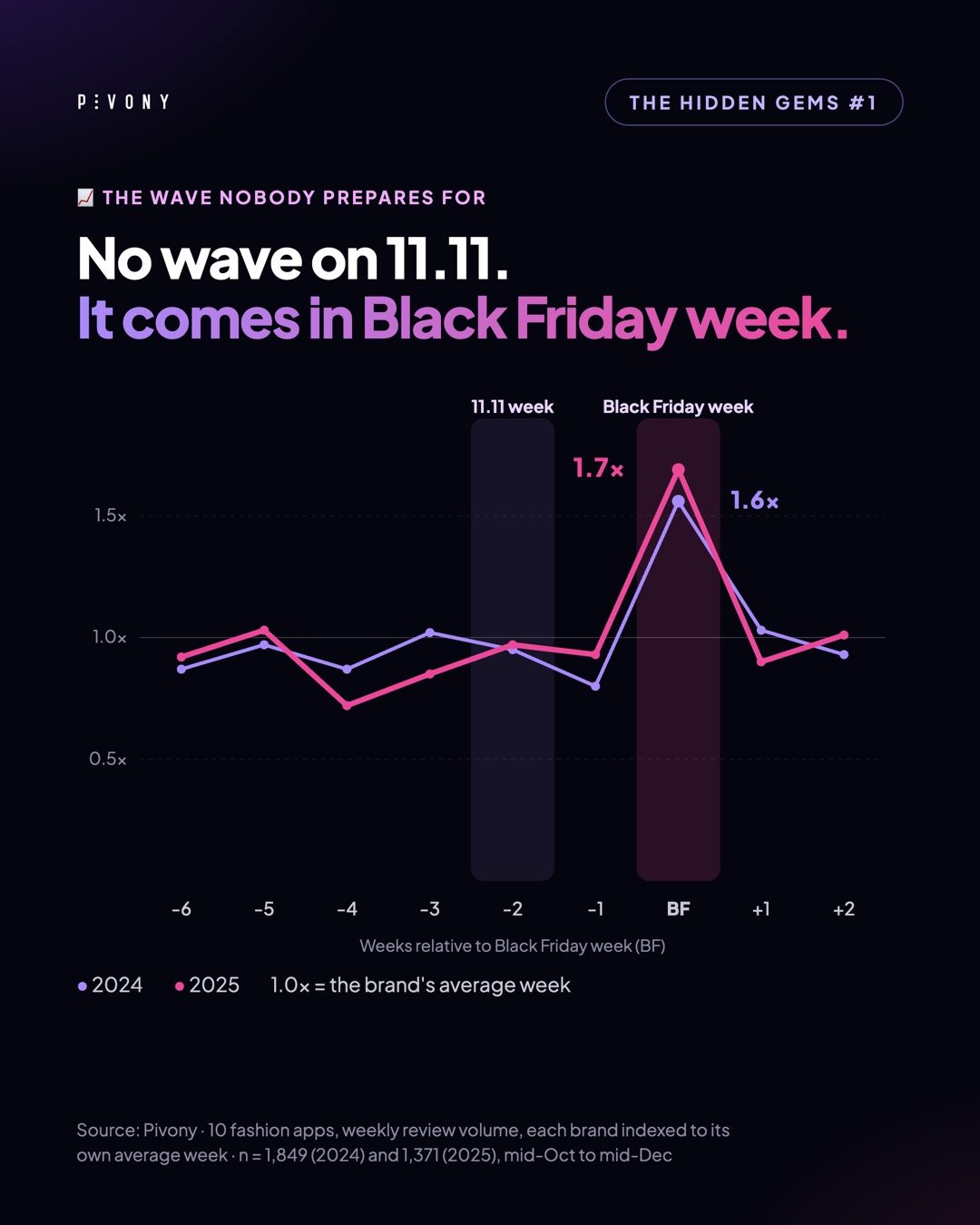
Source: Pivony · weekly review count, each brand against its own average week (equal weight) · n = 1,849 (2024) and 1,371 (2025) reviews, mid-October to mid-December.
2. The hidden issue: "It sold out while I was paying"
This is the complaint that hurts most, and it is rarely labelled as what it really is.
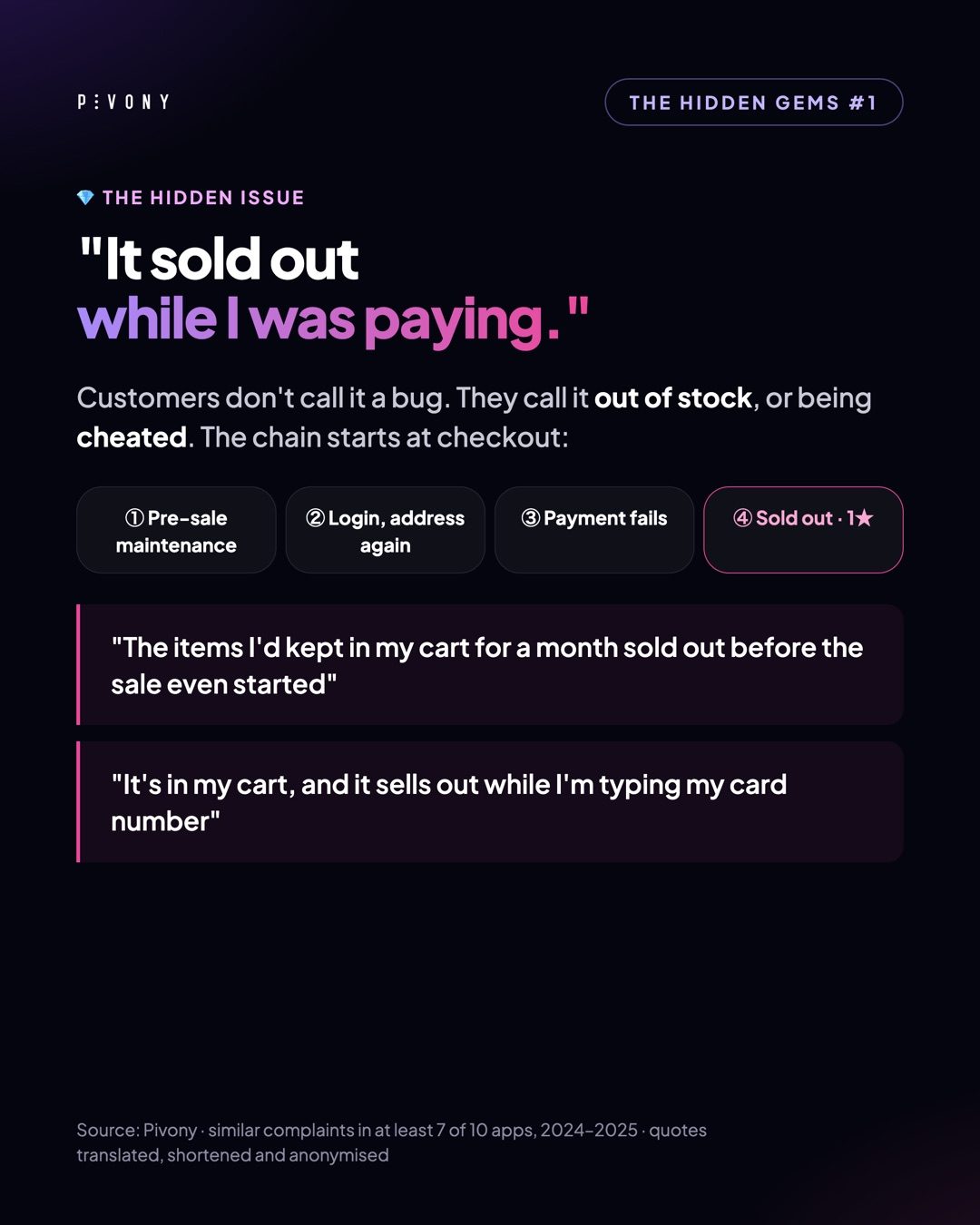
Customers keep items in their cart for weeks. The sale opens. The app goes into maintenance, logs them out or asks for their address again. The payment is declined once, then again. By the time it goes through, the item is gone.
> "The items I'd kept in my cart for a month sold out before the sale even started." > > "It's in my cart, and it sells out while I'm typing my card number."
Customers don't write "payment error". They write "out of stock", or worse, that they were cheated. A glitch at checkout turns into a stock complaint and a one-star review, and the team that could fix it never sees it on its own dashboard. We found a version of this story in at least 7 of the 10 apps.
3. The problem doesn't end when the sale does
In December, the share of reviews that mention delivery, returns or customer service nearly doubles: 14.9% in November, 27.3% in the first three weeks of December. In December, 96% of the reviews that mention customer service are negative.
For marketing, Black Friday is a one-day event. For operations it is a three-week one.
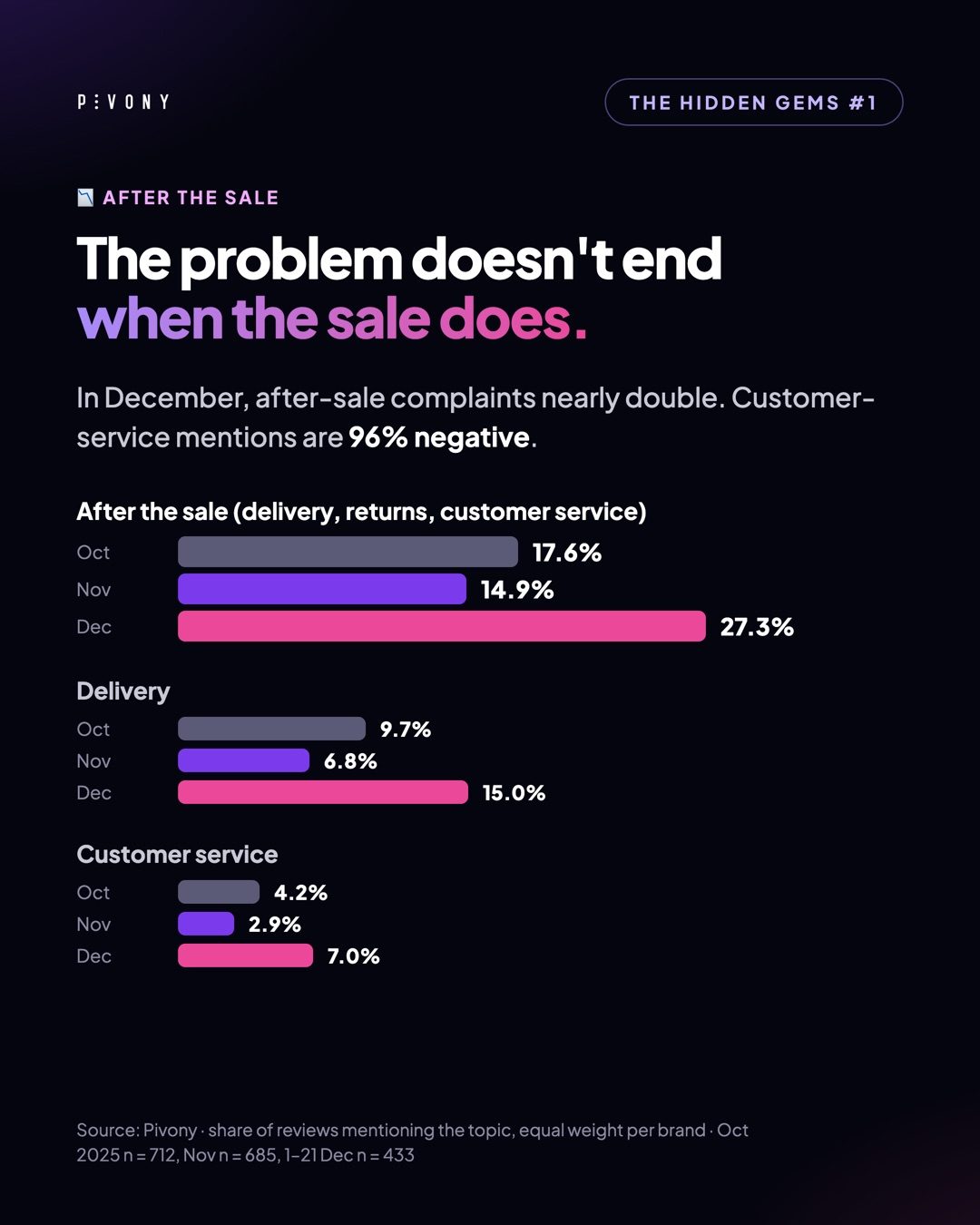
Source: Pivony · share of reviews mentioning the topic, equal weight per brand · October 2025 n = 712, November n = 685, 1–21 December n = 433.
4. What customers love: the clothes
The most positive topic in the data is product quality: only 19% of those reviews are negative. Some brands stand out in other areas too. At one international brand, 95% of product-quality reviews are positive. At one Turkish brand, the returns experience is rated positively at twice the sector average.
According to Pivony's sentiment analysis, about one review in three is mixed: praise and complaint in the same text. The typical pattern starts with "the product is nice, but…". Customers love the product and are angry at everything around it.
If you want to hear about size and fabric, the app store is not the place: only 8% of these reviews mention size or quality. That story is in your return reasons, your product reviews and your call-centre notes.
5. A case: two words, a wave of one-star reviews
In October 2025, one app cancelled orders placed with a discount code. The cancellation message said it was done "at your request". The customers had made no such request. Within 48 hours, about ten one-star reviews said almost the same thing.
The cancellation was probably unavoidable. The message was not.
Three things to do on Monday
- Before the sale opens (e-commerce and IT): keep carts through maintenance, and don't ask customers to log in or re-enter their address again. Load-test for the hour the sale opens, not for Friday morning.
- When the sale opens (CX and marketing): say clearly that a cart is not a reservation. For sold-out items, make "notify me when back in stock" easy to find.
- After the sale (customer service and logistics): plan December's delivery and returns capacity now. Never blame the customer in a cancellation message.
The cards are based on Pivony's topic analysis; the recommendations are our team's.
Our forecast for 2026
If the pattern of the last two years repeats:
- For apps that open the sale the evening before, the hardest day of the year will not be Black Friday but Thursday 26 November 2026, with the peak in the first 2–3 hours after opening.
- In Black Friday week, review volume will exceed 1.5 times a normal week; 11.11 week will look like a normal week.
- In December, reviews about delivery, returns and customer service will be more than 25% of all reviews.
We will follow 11.11 and Black Friday live and report whether the forecast held. If we are wrong, we will say so.
A warning: the public signal is shrinking
In our sample, the number of reviews written for these apps in November fell 24% in a year (from 907 to 685). There are several possible reasons: part of the shopping may have moved to marketplaces, or users may write fewer reviews as apps mature. Either way, one channel no longer shows the full picture.
Pivony is an AI customer experience and customer intelligence platform for mid-size and enterprise companies. It asks customers for feedback in writing or by AI phone call, analyses every answer together with support tickets, calls and reviews, and shows which segment and which problem move the score.
How we did it
- Data: only public app-store reviews (Google Play and App Store, Turkey, Turkish) for the apps of 10 fashion brands focused on womenswear, analysed with Pivony's Voice of Customer topic and sentiment models.
- Weighting: shares were calculated within each brand and averaged with equal weight, so no single app decides a result. Four of the ten apps belong to the same group; the others balance this.
- Quotes: translated, shortened and anonymised.
- Limits: review volume shows the experience customers chose to write about, not sales. The discount-season sample is small (1,830 reviews in October–December 2025), so read the numbers as patterns, not exact measurements.
Want the same analysis for your brand, together with your returns, survey and call-centre data? Ask for a free root cause analysis or book a demo.
Frequently asked questions
When do fashion app complaints peak in the discount season?
In 73,360 Turkish fashion-app reviews analysed by Pivony, review volume in Black Friday week was 1.6 times a normal week in 2024 and 1.7 times in 2025, while 11.11 week looked like a normal week. For apps that open the sale the evening before, the hardest hours were the first hours after opening, on the Thursday.
Why do customers say an item "sold out while I was paying"?
In at least 7 of the 10 apps, the pattern was a checkout chain: maintenance before the sale, being asked to log in or enter the address again, and declined payments. By the time payment went through, the item was gone. Customers report it as a stock problem, so the team that owns checkout often never sees it.
What happens to customer complaints after Black Friday?
They grow. In 2025, the share of reviews mentioning delivery, returns or customer service went from 14.9% in November to 27.3% in the first three weeks of December, and 96% of December reviews that mentioned customer service were negative.
How was this research done?
Pivony analysed only public Google Play and App Store reviews in Turkish for the apps of 10 fashion brands focused on womenswear, with its Voice of Customer topic and sentiment models. Shares were calculated per brand and averaged with equal weight. No brand is named or ranked, and quotes are anonymised.
See root causes on your own feedback
Book a 15-minute demo, or get a free RCA in 48 hours with no sales call.