
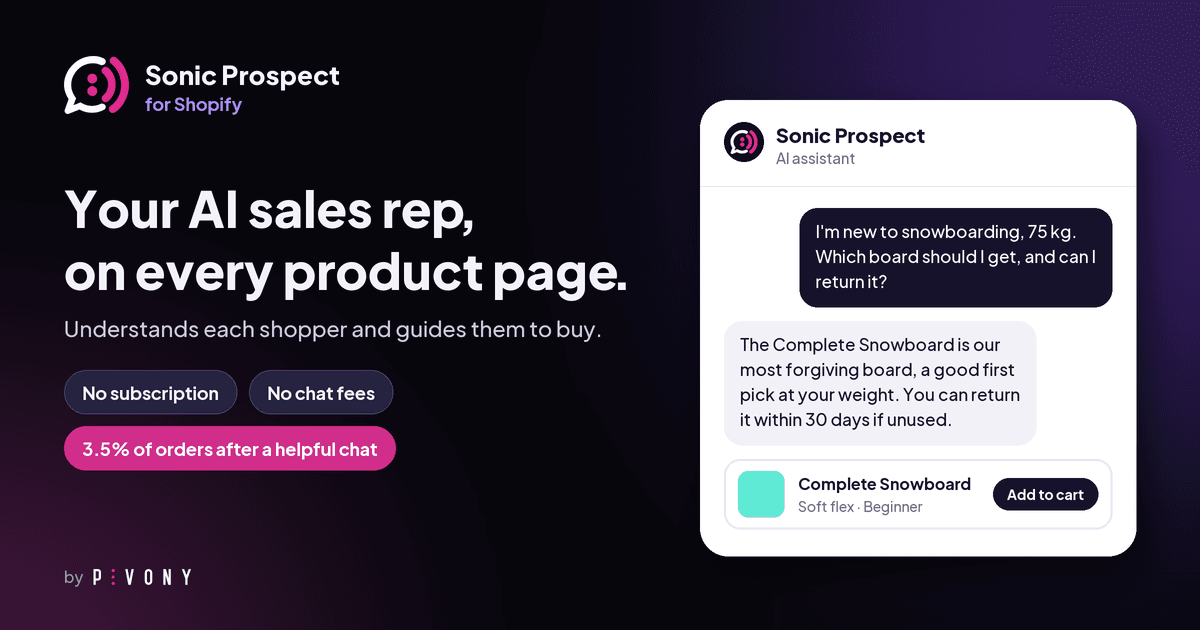
Sonic Prospect for Shopify: an AI sales rep on every product page
Shopify merchants do not wake up wanting “another widget.” They want the person already on the collection page, in the cart, or bouncing from a size chart to leave as a buyer.
That is why so many searches look like Shopify chatbot, Shopify sales bot, Shopify sales agent, or Shopify sales assistant. The words are different. The job is the same: help shoppers decide, using your store’s own products and policies — not turn every visit into a support ticket.
Sonic Prospect is an AI sales agent on that storefront. It is not a replacement for Shopify Inbox when someone asks “where is my order?” Order tracking and returns stay with your existing support. Sonic Prospect stays with the shopper while they decide, recommends from your catalog, and can add the right variant to cart.
Merchants start on Sonic Prospect for Shopify. Install and billing are through Shopify. No separate Pivony account.

Sales agent, not a FAQ script
A typical storefront chatbot is hired to deflect: shipping times, return windows, “do you ship to Canada?” Those answers matter. They are also the wrong scoreboard for revenue if that is all the agent does.
A sales agent runs a different loop: listen, understand what this shopper needs, guide them to the right product, and help them buy. “Do you have this in navy?” is sometimes fit. Sometimes it is stalling. Sometimes it is a gift buyer who does not know the recipient. Sonic Prospect treats those as different journeys, not as the same FAQ.
You still need a support path. Just do not ask a support bot to do the selling.
The pre-purchase conversations that stall revenue
These are the moments merchants describe when they think they need a sales bot — and what the agent should do instead of pasting a policy link.
1. Cart open, checkout not submitted
Shipping, duties, or a coupon field that “must exist somewhere.” The visitor is not asking for a knowledge-base article. They are testing whether the store will meet them. A sales assistant should resolve the blocker in the journey they are already in — and notice if they were comparing landed cost with another tab.
2. Size, fit, and “I will just guess”
Fashion and footwear live or die here. The shopper has two sizes in the bag and a review that contradicts the size chart. Inbox macros cannot try the garment on. A sales agent can ask the right two questions, point to the fit note that matches this SKU, and stop treating every size question as a completed job.
3. Shade, formula, and “will this work on my skin?”
Beauty traffic is high-intent and high-anxiety. They have a photo of their current bottle. They want a match, not a catalog dump. This is consultative selling on a product page — exactly where a generic chatbot recites ingredients and loses the sale.
4. Specs vs the competitor tab
Electronics, outdoor, kitchen: the visitor can recite three SKUs. They want a reason to stay. A sales agent should work the trade-off (weight, warranty, bundle) instead of repeating the bullet list they can already read.

5. Gift shoppers
They do not wear the size. They do not know the scent. They will bounce if the assistant interrogates them like a returning VIP. The agent should switch mode: occasion, recipient, “good enough” constraints — then help them complete a gift purchase from what your store actually sells.
6. Drops, restocks, and waitlists
Limited inventory creates frenzy chats that look like demand. Many of them are tire-kickers refreshing the page. The agent should answer what is in stock, what is comparable, and when a restock is published — without inventing availability.
7. International visitors stuck on duty and VAT
They want the product. They do not want a surprise at the door. Policy pages are dense. An agent that can walk landed cost in the moment, from your published shipping and tax pages, is doing pre-purchase work — not ticket deflection.
8. Collection lurkers vs SKU-ready buyers
One visitor is mood-boarding a whole look. Another has a SKU in the URL and a payment method ready. Treating them as the same session wastes both. Journey context is the difference.
9. Flash-sale traffic
Paid ads can fill chat. That is not a pipeline. After the sale, you want to know which chats actually helped someone choose. LEARN is how the storefront gets smarter next time — not how you send more automated “How can I help?” bubbles.

What “sales assistant” should mean on a Shopify store
A sales assistant that only greets and routes is a receptionist. Useful. Incomplete.
Sonic Prospect treats the storefront like a sales conversation: needs, objections, comparison, timing. It answers from your published products, policies, pages, and blog. It never invents products, prices, or policies. It does not handle order tracking or post-purchase support.

The opportunity: you do not pay for the chat
Most merchants price a storefront chatbot like a phone line.
On Sonic Prospect, the chats themselves are free. A visitor can ask about navy, size 42, the oak finish, and a gift note. That session does not become an invoice because they talked. There is no subscription and no per-chat fee.
You pay 3.5% of orders placed within 72 hours after a helpful chat. A helpful chat is one where the agent answered a real question about your products, sizing, shipping, returns, payment, or store policies. Greetings, unanswered questions, and post-purchase requests do not count.
There is no commission on your first $500 of those orders (order value, not commission). Shipping, taxes, tips, and gift cards are excluded. Full refunds and cancellations reverse the commission. You can see which chat led to each order and dispute any charge within 30 days. Billing is through Shopify.
So the bet is not another chatbot seat. The bet is: let the store talk, keep chatting off the invoice, and pay only when a helpful chat is followed by an order.
Start on your store
If you have been comparing chat tools because unpaid store traffic is tiring the team, start at Sonic Prospect for Shopify.
Product overview: Sonic Prospect. Get early access on that page — we will email you the install link as soon as Sonic Prospect is live on the Shopify App Store.
See root causes on your own feedback
Book a 15-minute demo, or get a free RCA in 48 hours with no sales call.