
Image: Galatasaray University Computer Engineering Department.
Green-SLM, built with Pivony, selected for COP31
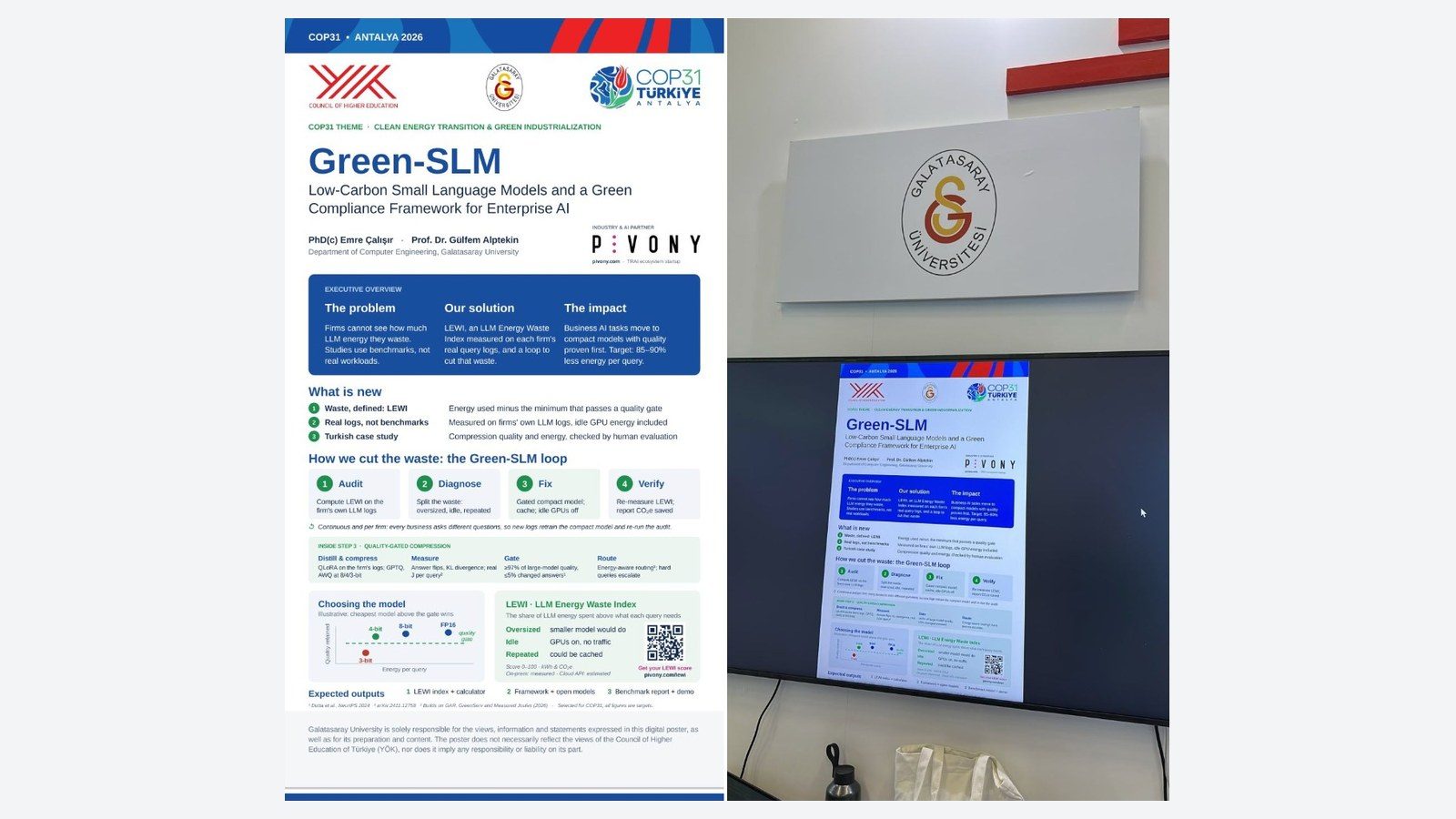
Galatasaray University selected six of its projects to present at COP31 in Antalya. One of them is Green-SLM: Low-Carbon Small Language Models and a Green Compliance Framework for Enterprise AI, developed by Prof. Dr. Gülfem Işıklar Alptekin of the Department of Computer Engineering and Emre Çalışır, PhD candidate in the department and founder of Pivony. Pivony is the project's industry and AI partner.
The project sits under COP31's theme of clean energy transition and green industrialization. Its goal is to cut the energy that enterprise AI uses and to make language model use more sustainable.
The problem
Companies cannot see how much energy their large language models waste. Research measures models on benchmarks, not on the questions a business actually asks every day. So nobody knows how much of the energy behind a company's AI is needed, and how much a smaller model, a cache or an idle-free setup would save.
LEWI: putting a number on the waste
The project proposes the LLM Energy Waste Index (LEWI): the energy a company's AI uses minus the minimum energy that still passes a quality gate. It is measured on each company's own LLM logs, not on benchmarks, and it counts idle GPU energy too. LEWI splits the waste into three parts:
- Oversized: a smaller model would have answered just as well.
- Idle: GPUs were on with no traffic.
- Repeated: the answer could have come from a cache.
LEWI is reported as a score from 0 to 100, together with kWh and CO₂e. On-premise models are measured; cloud APIs are estimated.
The Green-SLM loop
- Audit: compute LEWI on the company's own LLM logs.
- Diagnose: split the waste into oversized, idle and repeated.
- Fix: move each task to a compact model that has passed a quality gate, add caching, and switch idle GPUs off.
- Verify: measure LEWI again and report the CO₂e saved.
The loop runs continuously and for each company, because every business asks different questions: new logs retrain the compact model and re-run the audit.
Inside step 3, compression is quality-gated. The compact model is distilled and compressed on the company's own logs, then measured on answer flips, divergence from the large model and real energy per query. It moves into production only if it keeps at least 97% of the large model's quality with no more than 5% changed answers. Hard queries are still routed to the larger model.
What the project aims for
The target is 85–90% less energy per query for business AI tasks that move to compact models, with quality proven first. The poster marks all figures as targets. The project includes a Turkish case study, where both compression quality and energy are checked by human evaluation.
Planned outputs:
- the LEWI index and a calculator;
- the Green-SLM framework and open models;
- a benchmark report and a demo.
Get your LEWI score
You can get an estimate for your own AI workload with the LEWI calculator: enter your usage and see a LEWI score, the energy wasted per year and what a Green-SLM setup could save. It is an estimate, not an audit; real energy per query depends on hardware, batching and prompt length.
The poster is Galatasaray University's work. It does not necessarily reflect the views of the Council of Higher Education of Türkiye (YÖK).
See root causes on your own feedback
Book a 15-minute demo, or get a free RCA in 48 hours with no sales call.